
Federal Supreme Court, 22.08.2025, 1C_262/2024
Facts
The dispute concerns a construction project on an undeveloped plot (No. 378) located at the "Obermüli Süd" site in Baar (ZG). This site is part of the "Spinnerei an der Lorze" complex, a built-up site of national importance listed in the ISOS federal inventory. The ISOS recommends preserving the plot in question as an undeveloped meadow.
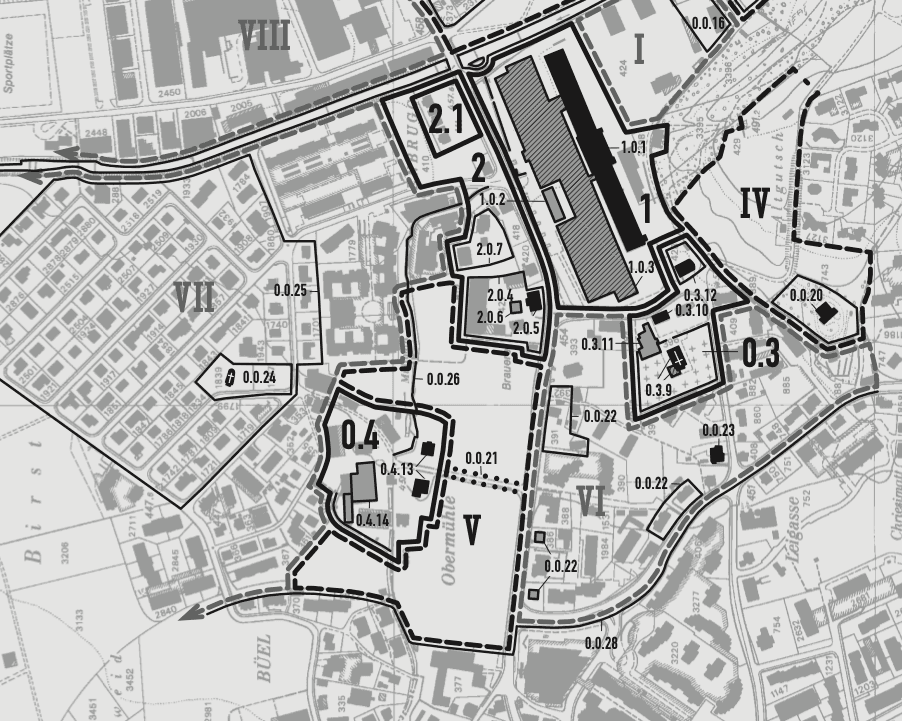
In 2003, the municipality of Baar revised its zoning plan, which classified this plot as a building zone. This plan entered into force without being challenged. In 2021, the municipality adopted a special plan and a partial revision of the zoning and alignment plans to allow for the development of a residential and commercial project on the said plot.
Neighbors, who own an adjacent plot, opposed the project. Their appeals were successively rejected by the Council of State and then by the Administrative Court of the Canton of Zug. They appealed to the Federal Supreme Court, arguing primarily that the special plan violates federal law because the 2007 base zoning plan did not sufficiently take into account the ISOS protection objectives.
Law
The Federal Supreme Court reiterates the legal status of the ISOS. Outside the performance of federal tasks, federal inventories such as the ISOS are not directly binding on property owners. However, they must be taken into consideration by cantonal and municipal authorities during their planning processes (Art. 6 LPN) (consid. 4.3).
Zoning plans are treated as administrative decisions. They must be challenged at the time of their adoption. Once they have entered into force, they benefit from the principle of plan stability and can no longer be called into question at a later stage, for example during the review of a detailed plan or a building permit application (consid. 4.4).
A preliminary review of a zoning plan that has entered into force is only possible under very strict conditions: if the affected parties could not have been aware of the imposed restrictions at the time the plan was adopted, if they did not have the opportunity to defend their interests, or if the factual or legal circumstances have changed so significantly that the plan has become illegal (Art. 21 para. 2 LAT). According to case law, neither the clarification of the scope of the ISOS by the judgment ATF 135 II 209, nor the introduction of the principle of inward development into the LAT in 2014, constitute such a significant change in legal circumstances as to justify a preliminary review (consid. 4.5).
Application to the specific case
The Federal Supreme Court notes that the appellants are in reality challenging the legality of the 2007 zoning plan, which classified the plot as a building zone. However, this plan has entered into force, and the appellants have not demonstrated that the conditions for a preliminary review were met. They should have challenged this classification as a building zone at the time of its adoption, as the consequences of such a classification were foreseeable (consid. 4.5).
The principle of the plot's suitability for construction is therefore definitively established and can no longer be questioned at the stage of adopting the special plan. At this stage of planning, the question of "whether" has been settled; only the question of "how" remains, to a certain extent, open. Similarly, the consideration of the ISOS can only relate to the "how" of construction. The appellants' criticisms essentially aim to challenge the very principle of construction, which is equivalent to an inadmissible challenge to the base plan (consid. 4.7).
The Federal Supreme Court finds that the appellants' arguments regarding the specific details of the project are not sufficiently substantiated to demonstrate that the weighing of interests carried out by the cantonal authorities was arbitrary (consid. 4.8).
Outcome
The Federal Supreme Court dismisses the appeal to the extent that it is admissible. The legal costs are borne by the appellants, who must also pay compensation for legal fees to the company that owns the plot.
Silex newsletter published in collaboration with Daniel Hirschi-Duckert, Attorney at Law